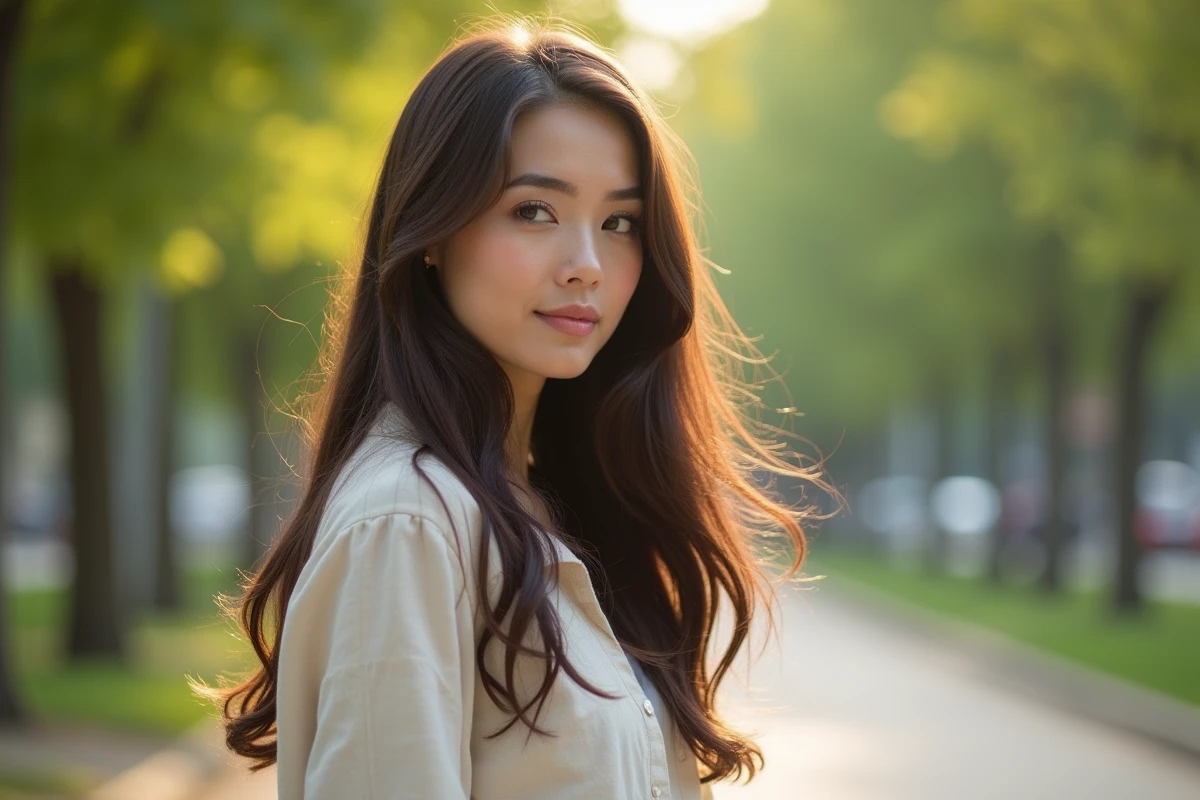
The proportion of men declaring a preference for long hair on women hovers around half of respondents in most recent surveys. This figure, often cited without context, masks a much more fragmented reality. Men’s preferences regarding hair length depend on the type of relationship envisioned, generation, professional environment, and hair parameters that length alone does not summarize.
Serious relationship or casual encounter: two distinct hair preference frameworks
We observe a recurring methodological bias in surveys about hair attractiveness: the question asked almost never specifies the relational context. A stated preference for long hair in the absolute does not indicate what the same man would find attractive in a casual dating scenario or in a couple projection.
The available data suggests that the relational context modifies the stated preference. In a projection towards a lasting relationship, long hair is more often associated with perceived traits like stability or conventional femininity. In a casual dating context, short or asymmetrical cuts generate a signal of boldness that attracts a different profile of attention. To explore this subject in detail, check out this analysis of men’s preferences regarding hair length.
This distinction almost never appears in mainstream content, which treats preference as a monolithic block. Reducing the question to “do men prefer long or short hair” is akin to asking if people prefer red or blue without specifying whether it’s a car or a living room wall.

Generational divide on women’s short cuts
Men under 35 are much more accepting of short hair than their elders. A 2022 report from the YouGov institute on perceptions of women’s cuts shows that men aged 18 to 34 report appreciating pixie cuts, short bobs, and shaved heads significantly more often than men over 50, who remain oriented towards hair above the shoulders or longer.
This generational polarization renders any global statistic like “the majority of men prefer long hair” obsolete. The majority in question is skewed upwards by the older cohorts. Among those under 35, the distribution tends towards a balance, or even an inversion in certain urban segments.
Factors accelerating this shift
- Exposure to visual social networks (Instagram, TikTok) where women’s short cuts generate high engagement, normalizing these looks among a young male audience
- The proliferation of public figures sporting pixie cuts or shaved heads, which shifts the perception of what is considered “feminine”
- A partial rejection, among younger generations, of inherited gender codes, where hair length served as a binary marker of male/female
We recommend taking any survey that does not segment by age with a critical distance. The aggregated figure is a statistical artifact more than a reflection of real desires.
Professional environment and perception of competence: when short hair becomes an asset
Sector norms influence stated preferences in a way that articles focused on romantic appeal systematically overlook. In what are deemed “creative” or “tech” environments, short or androgynous hairstyles are more often associated with competence and creativity than long hair.
This phenomenon creates an interesting paradox: a man working in design or tech may declare a preference for long hair “in general” while being more attracted, in his daily environment, to a woman with short hair whom he unconsciously associates with his own value system. Abstract aesthetic preference and actual attraction in context do not always coincide.

In more conservative sectors (finance, law, administration), long hair is still more perceived as conforming to presentation expectations. Hair length still functions as a signal of social conformity, which skews stated preferences towards long.
Hair volume and texture: parameters that length alone does not capture
Reducing hair attractiveness to length alone is an analytical error. Thickness and volume matter as much, if not more, than length in male perception. The volume and apparent health of hair create a much broader consensus than the mere question of length.
Shine, density, and texture send biological signals related to health and vitality. A short, voluminous, and shiny bob outperforms, in terms of perceived attractiveness, fine and dull long hair. Surveys that only measure length miss this hierarchy.
What men actually evaluate without articulating it
- Hair density: thick hair, regardless of its length, is associated with youth and health
- Shine: dull or porous hair sends a signal of nutritional deficiency or stress, perceived negatively even without conscious analysis
- Movement: the ability of hair to move naturally (what hairdressers call “fall”) attracts more attention than static length
The visible health of hair takes precedence over its length in spontaneous evaluation. This finding should guide haircut choices towards what enhances volume and texture rather than towards systematic lengthening.
Men’s preferences regarding women’s hair length do not form a stable block. They vary according to the age of the respondent, the type of projected relationship, the professional sector, and, above all, they are influenced by parameters (volume, shine, movement) that the question “long or short” does not measure. Any woman who adapts her cut to an assumed universal male preference is working with an outdated map.