
The illustrated travel journal is no longer just a simple sketchbook filled with vacation drawings. Today, it functions as a hybrid object, halfway between a diary, a scrapbook, and a planning tool, where itineraries, drawings, glued photos, transport tickets, and handwritten notes intertwine. This transformation changes the way travelers document their journeys and raises questions about what distinguishes a personal journal from a true editorial project.
Paper, weight, and medium: the technical foundation of the travel journal
Before discussing inspiration or destination, a travel journal is built on a choice of medium. Recent recommendations clearly distinguish between journals intended for writing and dry drawing (pencil, fine marker) and those meant for watercolor, gouache, or collage. The latter requires paper with a sufficiently dense weight to limit distortions caused by moisture.
This technical criterion, rarely addressed in mainstream guides, conditions the entire experience. A journal that is too thin warps at the first wash, rendering the following pages unusable. Conversely, thick paper adds weight and complicates backpack transport.
Travelers who practice mixed techniques (painting, collage, stamping) often opt for journals with open binding or rings, which better tolerate the thickness added by glued elements. To explore galleries of illustrated journals and find layout ideas, the stories published on voyager-en-images.fr showcase this diversity of formats.
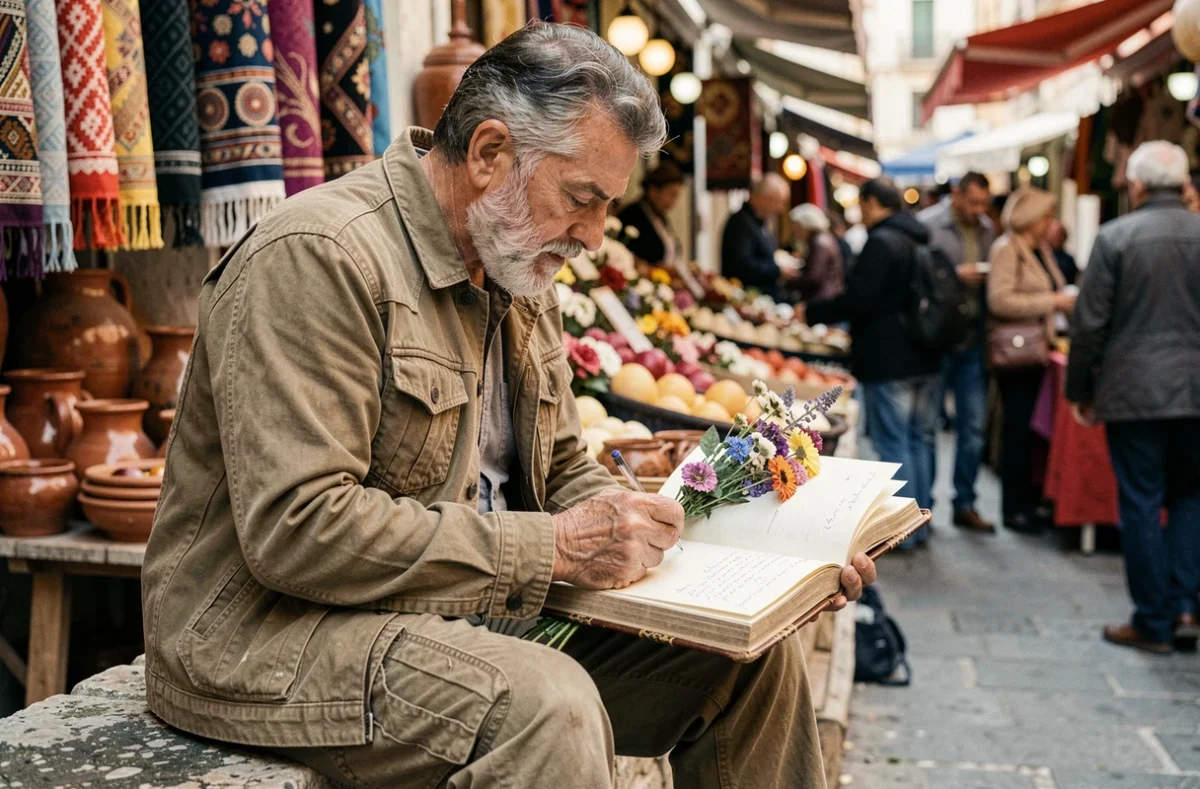
Art journal and travel journal: a blurry boundary between drawing and narrative
The practice of the travel journal increasingly borrows from art journaling. This shift, documented by several recent creative guides, transforms the journal: the focus is no longer on the fidelity of the sketch but on visual experimentation. Acrylic paint, washi tape, magazine cutouts, colored inks, and stamps coexist on the same double page.
This approach liberates travelers who do not see themselves as artists. However, it raises a question of readability. A journal saturated with collages and textures sometimes loses the thread of the actual travel narrative. Field reports vary on this point: some journalers advocate for total abstraction, while others emphasize the narrative function of the journal, with dates, places, and clearly identifiable anecdotes.
Printables and customizable elements
Printables (thematic maps, labels, page backgrounds, cut-out stickers) enhance the editorial dimension of the journal. They allow for structuring a narrative around a specific theme: local cuisine, family road trip, or regional exploration. These ready-to-stick elements facilitate layout for those who lack time on-site.
Their use raises a limitation: the journal risks resembling a standardized album if the printables overshadow personal traces (awkward drawings, spontaneous writing, coffee stains). The balance between prefabricated elements and on-the-spot creations remains the main challenge.
Festivals and publications: when the travel journal becomes an editorial object
The illustrated travel journal has a structured editorial ecosystem in France. Several festivals and specialized journals honor this practice by offering workshops, meetings, and publications of illustrated stories.
These publications reveal a gap between the personal journal and the editorialized journal. The design of a published journal adopts a rigorous documentary method, with iconographic research, text verification, and professional layout. The transition from the field notebook to the printed book requires a selection and rewriting process that the spontaneity of travel alone cannot guarantee.

Field sketches and urban sketching
The urban sketchers movement, active in many French cities and internationally, extends the tradition of the travel journal in urban settings. Artists gather to sketch live scenes from the streets, markets, or facades. This collective practice adds a social dimension to the journal, which remains a solitary exercise.
Sketching live imposes constraints absent from studio work: changing light, crowds, physical discomfort. These constraints produce specific graphic results, often more vibrant than illustrations reworked afterward.
Building an illustrated travel journal: concrete choices
A successful journal relies on a few decisions made before departure. Here are the technical choices that condition the final result:
- The format of the journal: a small format (A6, A5) fits into a pocket and encourages quick sketches, while a large format (A4) offers more freedom for complex compositions but is harder to transport
- The type of binding: sewn (more durable, opens flat), glued (cheaper, risk of pages detaching) or ring-bound (tolerates thick collage additions)
- The portable drawing kit: limiting materials to a few markers, a water brush, and a compact watercolor palette avoids clutter without sacrificing variety in rendering
- The space left for writing: alternating illustrated pages and handwritten text pages structures the narrative and facilitates re-reading months later
These choices are not neutral. A journal designed for collage will not have the same binding as a sketchbook for pencil drawing. The available data does not allow for designating one format as superior to others: it all depends on the primary medium and the travel context.
The illustrated travel journal remains an object whose value lies in its uniqueness. Whether it serves as a graphic draft, a family logbook, or a completed editorial project, its strength lies in the intersection of direct observation and creative gesture. Tools evolve, mediums diversify, but the principle remains: to put on paper what the photo alone cannot capture.